
Denver Court Records After Arrest
A Denver jail arrest creates a custody record first. The person is booked into Denver Sheriff custody, often through the downtown detention and court complex for new pending charges. Denver Pretrial Services assesses defendants booked into Van Cise-Simonet before initial advisement. That work can include interviews, criminal-history checks, CPAT scoring, and offense-specific tools for domestic violence or DUI cases. The result helps the court review release and supervision, but it is not the same as the final court case record.
The prosecutor then decides what charges to file. The Denver District Attorney's Office, led by District Attorney John Walsh, prosecutes state criminal violations in Denver's Second Judicial District. Jail charges can be amended, reduced, dismissed, added, or replaced after review. For custody and booking details, use Denver County jail inmate records. For booking-photo access, use the mugshot page. For filed charges, hearing dates, warrants, dispositions, and sealing, use the court record source.
Search Denver Court Records
Denver has both Denver County Court and Denver District Court functions. Misdemeanor, traffic, and municipal matters may be routed through Denver County Court. Felony criminal cases are generally Denver District Court or Second Judicial District matters. A person who starts with a jail roster result may not know which court has the filed case, so the charge level, case number, and court shown on any jail or prosecutor paperwork should be checked carefully.
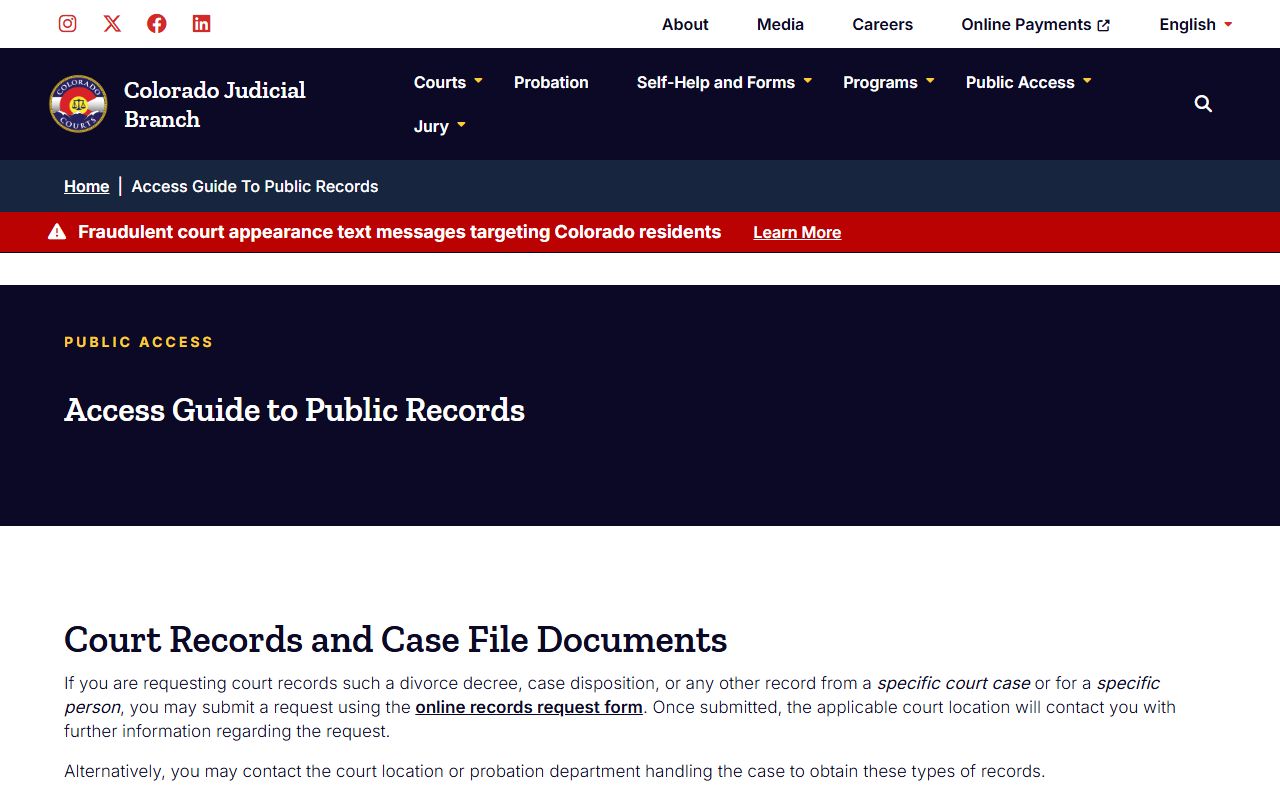
The Denver County Court site is the official path for county-court matters. The Colorado Judicial Branch public-record access guide says Denver County Court records requests can be sent to coradatarequests@denvercountycourt.org. For other Colorado court case information, the guide says to contact the court where filed, complete an online records request, or use a commercial real-time register of actions source, while warning that online data is not the official court record.
- Start with the booking number or name from the Denver Sheriff roster.
- Identify whether the matter is Denver County Court or Denver District Court.
- Search or request by case number when available, because name searches can return several people.
- Review the filed charges, status, court dates, bond terms, and disposition fields.
- Contact the filing court for older, restricted, sealed, or non-indexed records.
Denver Court Lookup Fields
Court search fields differ from the jail roster. A jail booking number identifies a custody event. A court case number identifies a case file. A defendant name can help, but it may be less precise than a case number if the name is common or spelled differently across systems.
| Field label | Type | Required | Notes |
|---|---|---|---|
| Case number | Text | Often preferred | Colorado case formats vary by year, court, and case type. |
| Party or defendant name | Text | Optional in many routes | Useful when the case number is unknown; spelling matters. |
| Court or county | Dropdown or request field | Often needed | Denver County Court and Denver District Court are different record paths. |
| Date range or docket date | Date field | Optional | Helpful for older or non-indexed records. |
The Colorado Judicial Branch records guide image below is matched to this page because it explains the official court-record access route and Denver County Court contact context.
Use court channels for filed charges and dispositions, then use the jail roster only for current custody and booking status.
Charges After a Denver Arrest
Charging documents are where the court record begins to separate from the jail arrest record. A complaint or information is usually filed by a prosecutor. An indictment follows a grand jury process. A person may be booked on one set of arrest charges and later face a different filed charge list. That is normal in criminal case processing and is one reason court records after a jail arrest should be checked before treating a booking charge as final.
| Document | Who uses it | What it means |
|---|---|---|
| Complaint | Prosecutor or court filing path | Starts or states criminal allegations in a filed case. |
| Information | Prosecutor | Formal prosecutor-filed charging document, common in felony cases. |
| Indictment | Grand jury path | Charges returned after grand jury review. |
Denver Charge Status Terms
Charge status is not the same as guilt. A pending charge is still open. A reduced charge has changed to a lesser offense. A dismissed charge ended without conviction on that count. A deferred judgment can involve conditions that may later support dismissal or sealing if completed. A conviction is a formal guilty plea or finding, not merely a jail arrest or booking.
| Status | Meaning | Records caution |
|---|---|---|
| Pending | Filed but not finally resolved. | Check later dates and amended filings. |
| Amended | The charge text or level changed. | The original booking charge may no longer match. |
| Reduced | The charge was lowered to a lesser offense. | Read the final disposition, not only the first filing. |
| Dismissed | The count ended without conviction. | Sealing may still require a separate process. |
| Conviction | Formal guilty plea or finding. | Different from arrest, booking, or charge filing. |
Bond Records After Denver Arrest
Bond is part of the early court path after a Denver jail arrest. Denver Pretrial Services has used pretrial services since the 1970s and the Colorado Pretrial Assessment Tool since 2012. The program provides information to the court for bond setting and pretrial supervision. It also reports supervision levels such as administrative, enhanced, intensive with electronic monitoring, and maximum supervision restrictions or home confinement.
Release is not always solved by paying money. A no-bond hold, warrant, detainer, or another agency hold can keep a person in custody. Denver Pretrial Services also warns that Community Corrections will never ask for or collect payment for pretrial services, release, assessments, diversion programs, electronic monitoring, or supervision. Suspicious calls can be verified with Denver Pretrial Services at 720-913-8900 or the DA Fraud Hotline at 720-913-9179.
| Term | Plain meaning |
|---|---|
| PR bond | Release on a promise to appear, often with conditions. |
| Cash bond | Money paid to secure release and court appearance. |
| Surety bond | A bail bond agent posts bond for a fee. |
| No-bond hold | Posting money alone will not release the person. |
| Detainer | Another agency or case may affect release. |
Warrants and Denver Court Records
The research did not locate a public Denver Sheriff active-warrant list. Denver Police and court records are the better routes for warrant and case-record questions. An arrest warrant or bench warrant can lead to a Denver Sheriff booking, but the underlying warrant may belong to the issuing court rather than the jail. If a person is arrested in Denver on another county's warrant, the Denver jail roster may show Denver custody while the main case file sits elsewhere.
Use Denver Police non-emergency, Denver County Court, or Colorado Judicial records channels for official warrant status. Court clerks can provide records access but cannot give legal advice. The Denver DA represents the people or state, not a public requester or defendant. A defendant who needs advice should contact counsel or the public defender.
Charge vs Conviction
Public court records after a jail arrest often show both accusations and outcomes. The difference matters for employment, housing, licensing, and personal decisions. A private reference page or public docket should not be used as a consumer report, and it should not replace the official court file.
| Concept | What it means | Denver record source |
|---|---|---|
| Arrest | Law-enforcement custody event. | Jail roster, police record, booking record. |
| Charge | Allegation filed or listed. | Court case file or jail booking detail. |
| Conviction | Guilty plea or finding. | Court disposition and judgment record. |
Sealed Denver Court Records
Colorado sealing rules can limit routine public access to certain arrest, non-conviction, or conviction records. The Colorado Judicial Branch sealing page and the CBI court-order sealing page are the official starting points for process questions. A sealed court record may reduce public access, but it does not mean every internal criminal justice record disappears.
| Term | Meaning | Public access effect |
|---|---|---|
| Sealed record | Hidden from routine public access by statute or court order. | May still be available to some agencies. |
| Expungement | A stronger record-clearing path in limited contexts. | Eligibility depends on Colorado law and case facts. |
| Restricted record | Juvenile, victim-sensitive, sealed, or active-investigation material. | May be withheld or redacted. |
Important: This resource is not a consumer reporting agency and is not for FCRA-covered screening decisions.